


| Quantity: | |
|---|---|
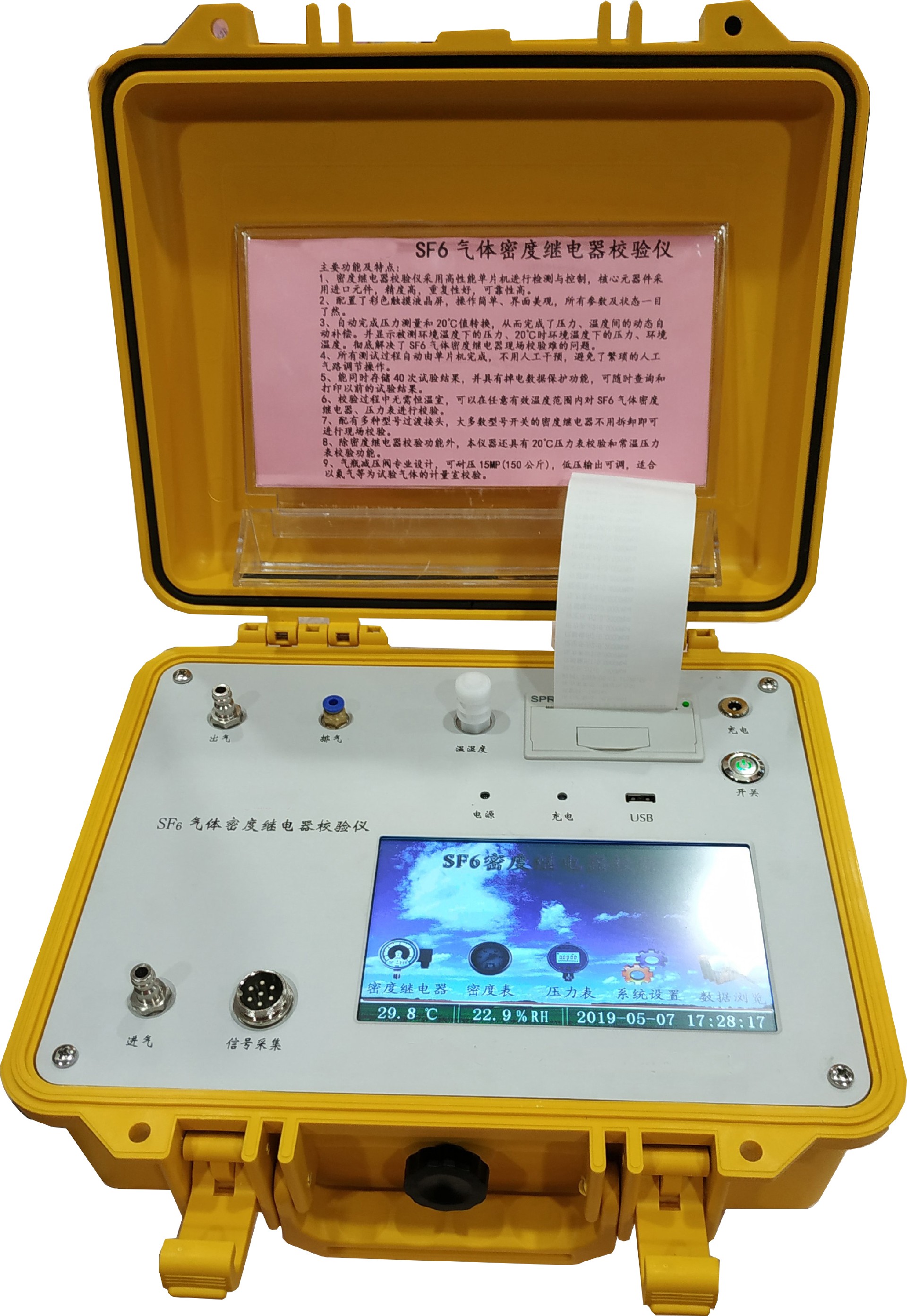
LSMD20/LSMD21
Main functions and features:
1. The density relay tester uses a high-performance microcontroller for detection and control, and its core components are imported, ensuring high accuracy, excellent repeatability, and high reliability.
2. Equipped with a color touch LCD screen, it features simple operation and a visually appealing interface, making all parameters and status clearly visible at a glance.
3. Automatic completion of pressure measurement and 20℃ value conversion, thereby achieving dynamic automatic compensation between pressure and temperature. It also displays the pressure at the measured ambient temperature, the pressure at 20℃ ambient temperature, and the ambient temperature itself. This completely solves the challenge of difficult on-site calibration of SF6 gas density relays.
4. All testing processes are automatically performed by a microcontroller, eliminating the need for manual intervention and avoiding tedious manual adjustments to the gas pathways.
5. It can store the results of 40 tests simultaneously and features power-loss data protection, allowing you to query and print previous test results at any time.
6. The verification process does not require a constant-temperature chamber and can be performed on SF6 gas density relays and pressure gauges within any valid temperature range.
7. Equipped with various types of transition connectors, the density relays of most switch models can be verified on-site without being removed.
8. In addition to the density relay calibration function, this instrument also features 20℃ pressure gauge calibration and ambient-temperature pressure gauge calibration functions.
9. The gas cylinder pressure-reducing valve features a specialized design and can withstand pressures up to 15 MPa (150 kg). Its low-pressure output is adjustable, making it suitable for calibrating metering chambers using test gases such as nitrogen.
Main technical specifications:
1、Test Objects: Alarm 1, Alarm 2, Lockout 1, Lockout
2、Over-voltage Alarm Contact Signal
2.Calibration Range: 0 ~ 1 MPa (Absolute Pressure)
3.Instrument Accuracy: 0.1 Class
4.Repeatability: ±% F.S. at 20°C
5.Pressure Display Resolution: 0.001 MPa
6.Inlet Pressure: 0.9 ~ 1 MPa (Gauge Pressure)
7.External Interface: USB (Supports USB flash drives up to 4 GB)
8.Operating Environment: Temperature -10 ~ 50°C (Optimal usage temperature 5 ~ 50°C), Relative Humidity 5 ~ 90% RH
9.Display Resolution: 800 × 480 pixels, Color Touch Screen
10.Storage Capacity: 40 sets
11.Measurement Contact Voltage: DC 24V
12.Temperature Acquisition Mode: Manual / Automatic
13.Inlet Connection: φ4 Push-in Quick Connector
14.Inlet Tubing: Standard φ4 / PFA tube
15.Measurement Connection: φ4 Push-in Quick Connector
16.Measurement Tubing: Standard φ4 / PFA tube
17.Exhaust Connection: φ4 Quick Connector
18.Exhaust Tubing: Standard φ4 / PFA tube
19.Mobile Power Supply: Rechargeable Lithium Battery Pack (Continuous operation for 8 hours)
20.Charging Voltage: 100 ~ 240 VAC, 50/60 Hz
21.Operating Voltage: 14.8 V DC
VRP Series Varnish Removal Oil Purifier
Application
Used in gas and steam turbine, compressor, to remove dissolved and suspended soft pollutants in oil products, sludge and other harmful substances. Avoid turbine failures and expensive oil changes due to paint film problems. When the film is formed, the loss of production is very high. The initial formation of the film is known as a soft pollutant, caused by hot spots in the system, such as bearings, pumps, and high flow on-line filtration. Recent studies have found that the existence of soft pollutants can be divided into dissolved state and suspended state, by removing these soft oxides can avoid the production of paint film. Once the film forms, it will clog valves, filters and other small links, and the life of the oil will be significantly reduced.
The formation of cleaning film will cause the following adverse consequences: valve adhesion, loss of control, resulting in unit failure or startup failure; Filter plugging, limiting oil flow, resulting in oil temperature rise and wear increase; Heat exchange failure, oil temperature rise; Sandpaper surface, increase component wear; Forming paint on the bearing, limiting flow, increasing wear and temperature; Frequent oil changes and system flushes. When the soft pollutants are dissolved in the oil, typically when the oil temperature is above 40℃, they cannot be removed by ordinary mechanical filtration or electrostatic filtration, and these soft pollutants show natural magnetism. For polar absorption, the cooler metal surface "cold spot", i.e. the valve and cooler. When the temperature of the oil is lowered, the thermal stability of the soft pollutants is less than that of the oil, so they are more likely to bake hard on hot surfaces, such as axial shafts.
VRP paint film cleaner. It achieves revolutionary and efficient removal of soft pollutants (dissolved and suspended) from oil products, including gas and steam turbines and compressors under high temperature operation. The warm oil is pumped from the lowest point at the bottom of the tank to the VRP paint film purifier by the equipment's own transfer pump. After cooling treatment (using the thermal stability of the paint film is worse than that of oil), the paint film, particulate matter and moisture are removed by the filter element with wood fiber as the raw material (no need to use ion-exchange resin filter material, greatly saving the cost of use).
Features:
● Increase system reliability and stability. ● No more shutdowns and startup failures caused by paint film.
● No longer need to clean the tank and system flushing. ● Increase jacking oil pressure, more stable bearing temperature.
● Improve the life of oil products, blood additives and system components, such as bearings, valves, seals, etc.
● Great savings can be achieved by avoiding turbine failure and extending the life of oil products. Features:
● Increase system reliability and stability. ● No more shutdowns and startup failures caused by paint film.
● No longer need to clean the tank and system flushing. ● Increase jacking oil pressure, more stable bearing temperature.
● Improve the life of oil products, blood additives and system components, such as bearings, valves, seals, etc.
● Great savings can be achieved by avoiding turbine failure and extending the life of oil products.
Technical Specification
|
Model |
VRP-10 |
|
Flow |
10L/min |
|
Working Pressure |
≤0.5Mpa |
|
Total Power |
5.55KW |
|
Power Supply |
AC380V/50Hz |
|
Overall Dimension |
1466mm×1126mm×1750mm |
|
Net Weight |
500kg |
|
Particle contamination degree(NAS1638)
|
≤6grade |
|
MPC data |
<15 |
■Above size and weight of this equipment are for reference only, the specific data shall be subject to its physical object.


 渝公网安备 50010702502819号